




Heading
More TicketsHeading
More TicketsRome Tourist Card - Prices, What's Included and Visitor Information
What Is The Rome Tourist Card?
- The Rome Tourist Card is a digital attraction pass that bundles some of the city’s most visited landmarks into a single ticket.
- Instead of booking everything separately, you can pre-purchase access to key sights like the Colosseum and Vatican Museums in one go.
- It’s a popular option for visitors who want to see Rome’s biggest attractions without having to book everything separately.
- You’ll still need to choose time slots for certain attractions, but once it’s set up, everything is handled digitally and sent straight to your phone.
What’s included in the Rome Tourist Card?
The attractions included depend on the option you choose, but you'll be able to visit:
- Colosseum, Roman Forum & Palatine Hill
- Vatican Museums & Sistine Chapel OR Castel Sant'Angelo
- St. Peter’s Basilica OR Pantheon
- Digital audio guide or app-based commentary
Some versions also include optional extras such as guided tours or fast-track entry at selected sites.
During checkout, you'll simply select which attractions you'd like to include.
How does the Rome Tourist Card work?
Once you’ve booked the pass, you’ll receive everything by email. From there, the process is fairly straightforward:
- Choose your travel dates
- Select time slots for attractions that require reservations
- Show your digital pass at the entrance
- Enter your booked attractions directly
There’s no need to collect tickets in person, and most entrances accept mobile scanning.
That said, the timing of your visits matters. Popular attractions like the Colosseum and Vatican Museums can sell out early, especially in peak season, so it’s best to plan ahead rather than leave bookings until the last minute.
Is the Rome Tourist Card worth it?
This depends a lot on how you like to travel and how long you’re staying in Rome.
It’s a good choice if:
- You’re visiting Rome for 2–3 days
- You want to see the main highlights without organising separate tickets
- You prefer everything sorted in advance
- You like having skip-the-line access included where possible
It may not be ideal if:
- You want unlimited access to museums and attractions
- You’re planning to explore lots of smaller, less touristy sites
- You’re looking for the cheapest possible way to visit each attraction individually
- You rely heavily on public transport (this pass doesn’t include it)
In general, the Rome Tourist Card works best as a “main highlights” bundle rather than an all-in-one city pass.
It’s about convenience more than maximum savings.
Rome Tourist Card vs Omnia Card
- The Omnia Card is the most comprehensive option and includes additional Vatican-related benefits, but it’s also significantly more expensive.
- If your main goal is just to see the major highlights, the Rome Tourist Card is usually the simpler option.
Things to know before you buy
A few practical points that are worth keeping in mind:
- You still need to reserve time slots for major attractions
- Entry times can book up quickly in busy months
- It doesn’t include public transport in Rome
- Some attractions require choosing between options rather than visiting all of them, for example Vatican Museums OR Castel Sant'Angelo
- It’s best used for planning ahead, not last-minute sightseeing
Once you understand these limitations, it becomes much easier to decide if it fits your trip.
Who should use the Rome Tourist Card?
- The pass tends to work best for visitors who want a straightforward way to see Rome’s biggest attractions without overthinking logistics.
- It’s useful if you’re short on time and prefer having everything organised before you arrive.
- If you’re the type of traveller who likes to plan each museum separately or wander without an itinerary, you may find you don’t really need it.
Rome Tourist Card
More TicketsAttraction Options for the Rome Tourist Card
The Rome Tourist Card includes some of the city's most visited landmarks. Here's a quick overview of what you'll see at each attraction.
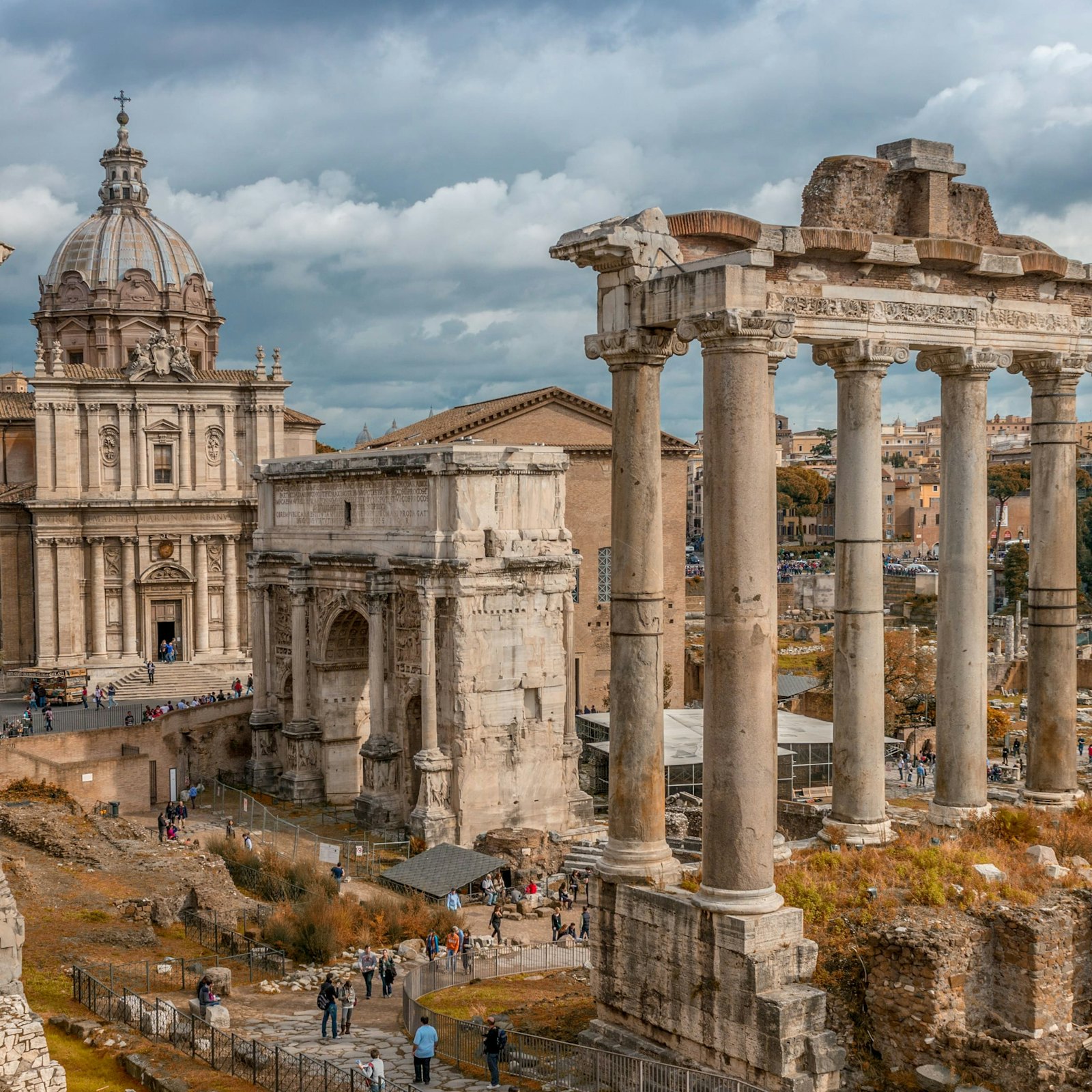
Colosseum, Roman Forum & Palatine Hill
- The Colosseum, Roman Forum & Palatine Hill on a self-guided tour.
Built nearly 2,000 years ago, the Colosseum could hold tens of thousands of spectators who gathered to watch gladiatorial contests, animal hunts and public spectacles. Today, it's one of the best-preserved reminders of Ancient Rome's power and influence.
The Roman Forum
The Roman Forum was used as a marketplace and the centre for political, commercial and social life in Rome. It would have been full of shops and stalls as well as holding events such as the funeral of Julius Caesar. The Roman Forum was buried for centuries and it wasn't fully recovered until archaeological excavations began in the 18th century.
Palatine Hill
Palatine Hill was home to many of Ancient Rome's emperors and wealthy families, making it one of the city's most prestigious areas. It was one of the seven hills of ancient Rome and holds important historical and archaeological significance as it's believed to have been the birthplace of Rome itself, by Romulus, the mythical founder, in 753 BC.
It mainly consists of ruins, but it's still one of the most fascinating parts of Ancient Rome. Walking through the remains of imperial palaces and gardens gives you an idea of how Rome's emperors once lived.
Vatican Museums & Sistine Chapel
- Visit the Vatican Museums including the Sistine Chapel and its famous ceiling frescoes.
The Vatican Museums & Sistine Chapel are one of the most popular landmarks and attractions in Rome. They are home to one of the largest and most impressive art collections in the world. The collection includes classical sculptures, Renaissance masterpieces, Egyptian artefacts, maps, tapestries and religious treasures gathered by the Popes over centuries.
The Sistine Chapel
The Sistine Chapel forms part of the Vatican Museums and is home to the famous ceiling frescoes painted by Michelangelo in the 16thcentury, and shows his interpretation of the story of creation and the great flood. Michelangelo also painted the scene of the ‘Last Judgement’ behind the altar.
St. Peter's Basilica
- Take a guided tour of St. Peter's Basilica
Enjoy a guided tour of St. Peter's Basilica, which is home to crypts, chapels and tombs of various historical figures. Learn about the history of the basilica and its artwork, while also taking you through areas containing crypts and tombs.
Castel Sant'Angelo
If you choose this option you can enjoy Castel Sant'Angelo, the mausoleum that was commissioned by the Emperor Hadrian for him and his family, and has since been used for multiple other purposes including Papal Residence, prison and fortress. Now home to an extensive collection of ancient artefacts.
Rome Pantheon
The Pantheon was originally commissioned by Agrippa and later rebuilt during Emperor Hadrian's reign. It is one of the best-preserved buildings from Ancient Rome. The building is famous for its domed roof and oculus which allows natural light to illuminate its interior. It served as a temple for all Roman gods, and its design has influenced Western architecture for centuries. It has been used as a Christian church since the 7th century.
Rome: City Audio Guide App for Your Smartphone
The downloadable audio guide app contains over 130 points of interest to see in Rome as well as offering high quality visuals and descriptions and audio commentaries by local experts.
The app also has an offline, digital map to help with navigation which comes in very useful.
Rome Tourist Card
More TicketsRome Tourist Card
FAQ

When you complete the purchase of the Rome Tourist Card, we will email you the ticket details and a personal discount code which you can use with your next purchase. Full details shown on the ticket.
The map is downloaded as part of the audio guide and as it's downloaded on your phone, you don't need wifi or mobile roaming to use it.
The Rome Tourist Card includes access to the Colosseum, Roman Forum and Palatine Hill as well as the Vatican Museums and Sistine Chapel and St. Peter's Basilica as well as a great audio guide and further discounts.
